The safest route is not always the shortest one, especially for people with mobility challenges. Walkability helps surface hidden accessibility barriers, supporting safer navigation for users and providing insights that can inform more inclusive urban design.
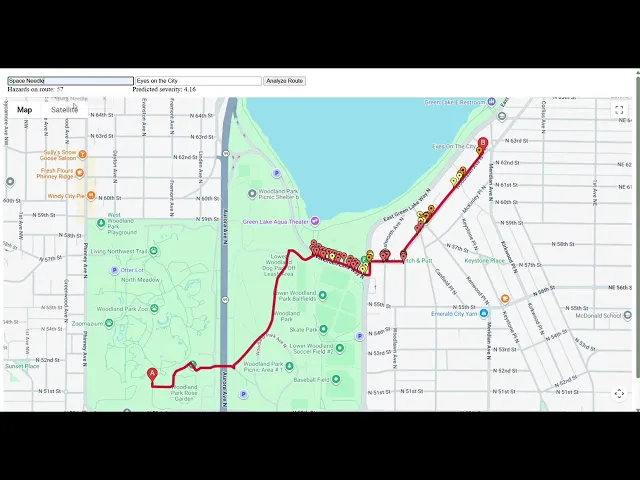
Walkability is a web application and a data visualization tool that evaluates the accessibility risk of walking routes using real-world hazard data and machine learning. Users can enter a start and end location in Seattle to view a route annotated with known hazards and an overall predicted risk score.
Our machine learning model analyzes nearby accessibility hazards using geospatial indexing and gradient boosting to predict route risk severity, which is visualized in real time with color-coded routes and interactive markers on Google Maps.
From a data analytics level, Walkability integrates accessibility data, public infrastructure datasets, and points of interest such as hospitals and transit access. Through visual components such as heatmaps, clustered markers, severity grids, and neighborhood risk comparisons, displayed on an interactive map, users can view localized hotspots of accessibility hazards on sidewalks.
Video Walkthrough
Walkability: Predicting and Analyzing Pedestrian Risks on Seattle Sidewalks
GitHub Repository